UNESCO sites in Indonesia: temples, parks and other amazing places
By Anna Skumina
13.12.2025
In a vast land of temples and jungles, there are an incredible number of historical and natural sites that deserve the close attention of historians, naturalists, art historians and travelers. In the official, confirmed list of UNESCO natural and cultural heritage sites in Indonesia, you will find 10 items. What exactly and for what reasons is of particular value to humanity and is protected by the Universal Convention - further in the article.

Depositphotos
Borobudur represents the essence of civilization and religious architecture of Southeast Asia. Translated from Sanskrit, its name means “temple on the mountain”. A majestic pagoda, temple or huge stone mandala. Whatever it is, Borobudur is the world’s largest symbol of Buddhism and impresses with its grandeur.
Year of registration at UNESCO: 1991.
The temple complex was built in the 8th century on the slope of the active and now Merapi volcano, rising 2,968 meters above sea level. After one of the massive eruptions of Merapi, Borobudur was buried under volcanic ash for 800 years. It was discovered only in 1814 and restored for another 20 years.
In height the temple reaches 35 meters. At the top there are 72 openwork stupas in the shape of bells, each of them has a statue of Buddha. The whole structure from a height looks like a huge stupa, or step pyramid, covered with thousands of bas-reliefs. Borobudur is a Buddhist view of the world. The two lower tiers represent Kamadhata – everything material and selfish, the next four levels of Rupadhata – the world of unselfishness, which lacks enlightenment, the top three round tiers of Arupadhata – the world overcoming selfishness and materialism.
Every year the temple is visited by about 3 million tourists. The mysterious place attracts with its architecture and historical significance. Many aspire to meet the dawn on the top of Borobudur, which has the symbolic meaning of a new beginning of life and purification.
A visit to Borobudur is paid. Adult ticket costs about $25, children's (from 3 to 10 years) about $15. For a fee at the entrance, local guides will offer their services, who can tell about the history and symbolism of the temple.

Depositphotos
The construction of the largest Hindu temple dedicated to Shiva was completed in the 10th century on the slope of the Merapi volcano, 20 kilometers from Borobudur.
Year of registration at UNESCO: 1991.
In addition to Prambanan, also called Loro Jongrange, it includes the temples of Sevu, Bubra and Lumbung. Sewu, with its four pairs of giant Dwarapala statues, is Indonesia’s largest Buddhist complex. This testifies to the peaceful coexistence of the two religions during the reign of the powerful Javanese Sailendra dynasty.
Separately, Prambanan, consisting of 240 temples, is a prime example of Hindu religious bas-reliefs that illustrate the Indonesian version of the Ramayana epic. Masterpiece stone carving testifies to the level of similar technologies in the 8-10 centuries.
All the buildings of the complex, which is more than 500 temples, are a large-scale archaeological park, an architectural and cultural treasure of Southeast Asia. Prambanan is a cult place of power and an inexhaustible source of impressions for tourists. Along with Borobudur, the Hindu temple plays an important role in the formation of Java, its history and civilization.
The cost of visiting Prambanan for foreign tourists is in the range of $ 25 for adults and $ 15 for children from 3 to 10 years.
Pay attention: complex tickets to visit Borobudur and Prambanan will save a little. They can be purchased from both temples. The validity period of the complex ticket is 48 hours.

Depositphotos
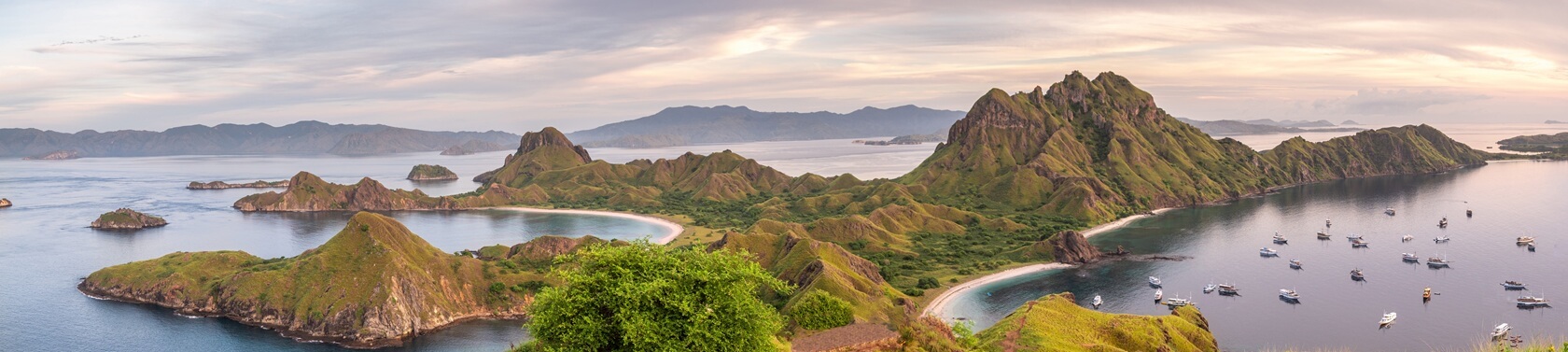
A conservation facility with unique terrestrial and marine ecosystems. Komodo National Park consists of three islands - Rincha, Komodo and Padar, as well as many smaller islets of volcanic origin and water areas around them. The dry climate caused an evolutionary adaptation of terrestrial flora - from grass shrouds to tropical, deciduous forests. The rugged slopes of the islands contrast sharply with sandy beaches and coral-rich reefs. All this creates fantastic landscapes of the "young" Earth.
Year of registration at UNESCO: 1991.
The most notable inhabitants of the islands are the giant Komodo dragons, or Komodo dragons. The name describes the appearance and aggressive behavior of the oldest lizards in the world, the average length of which is from 2 to 3 meters, and the weight reaches 70 kilograms. The rich Komodo coral reefs are home to a wide variety of species, and strong currents attract sea turtles, whales, dolphins and dugongs.
Due to measures to preserve the ecosystems of the park, the number of tourists who can visit the protected areas is limited to 200 thousand people per year. To get on a tour of the Komodo Islands, online pre-registration is required. Komodo is famous for its incredible dive sites and offers the services of Belgian diving company Manta Rhei.
The cost of the tour is about 260 US dollars. The ticket is revisited and valid for one year. Please note that it is impossible to get to the islands of Komodo Park on your own, only as part of a group or individual tour with a special ranger.

Depositphotos
The Sangiran Paleontological Museum is the site where the first fossils of a hominid dating back to about 1.6 million years were found during excavations in 1936-1941. Later, another 50 fossils were discovered, which is half of all found on the planet. Currently, the excavation area has an impressive size - about 48 square kilometers. Sangiran is one of the most important places in the world to study fossil man.
Year of registration at UNESCO: 1996.

Museum Sangiran
The park includes the Ujung Kulon Peninsula and several coastal islands, as well as the Krakatoa Nature Reserve. After numerous eruptions of Krakatoa volcano nearby settlements were permanently evacuated. Without human intervention, local nature has retained its uniqueness. The reserve is covered by raging mangrove forests and jungles. Ujung Kulon is the last habitat of the Javanese rhino. In addition to them, there are no more rare Javanese tigers in the park. More than 50 species of rare plants grow on the territory of the reserve, among which many species of animals and birds live. The park has a large number of endemics, that is, animals, plants and birds that are not found anywhere else in the world.
Year of registration at UNESCO: 1991.
Visitation: The easiest way to get to Ujung Kulon is to buy a tour in the resort town of Asnier, which is located 2 hours away by car from Jakarta.

Depositphotos
A huge protected area of Southeast Asia (2.35 million hectares). Truly wild territories, one of the last in the world. The untouched forests of Lorenz Park make up 90% of its territory. The uniqueness of the reserve is that it covers continuous zones - from the snow cap to the sea coast, with extensive marshlands. Here is the mountain Puncak Jaya (4884 meters), the highest in Australasia, also home to more than 630 species of birds and 123 species of mammals, home to several dozen indigenous peoples. These areas have the brightest biodiversity in New Guinea, with record levels of endemism for the planet.
Year of registration at UNESCO: 1999.

Arfani Mujib, CC BY-SA 4.0, via Wikimedia Commons
The site encompasses an area of 2.5 million hectares, encompassing three national parks on Sumatra Island Sumatra: Gunung Leuser, Kerinci Seblat, and Bukit Barisan Selatan. These vast territories potentially offer all the climatic conditions for the long-term preservation of internal ecosystems. The Sumatra Rainforest Heritage Site has been designated a protected natural site by the World Heritage Convention due to its vast and unique biodiversity of flora and fauna, including thousands of endemic species.
In the rainforests of Sumatra is the highest volcano of Indonesia Gunung Kerinci (3,805 meters above sea level), the highest mountain lake in Southeast Asia Gunung Tujuh, dozens of other volcanic and glacial alpine lakes, waterfalls, ancient caves and rocks.
Year of registration at UNESCO: 2004.

Depositphotos
The cultural landscape of Bali consists of five rice terraces and water temples covering an area of 19,500 hectares. The temples are the center of a joint water management system of canals and dams known as Subak, which was established in the 9th century. The landscape in the UNESCO list also includes the legendary Royal Water Temple Pura Taman Ayun, built in the 18th century. Subak reflects the philosophical concept of the Three Hita Karana (the Balinese doctrine of the three ways of the good life), uniting the spheres of the spirit, the human world and nature. This philosophy emerged from the cultural exchange between Bali and India over the past 2 millennia. The subac system has allowed the Balinese to become the most efficient rice producers in Indonesia, despite supply difficulties. First of all, the subac impresses with its uniqueness and is a significant work of agro-architecture..
Year of registration at UNESCO: 2012.
The beauty and uniqueness of the rice fields with the subak irrigation system arouses tourist interest. The most visited, due to its convenient location, are the Tegallang terraces near Ubud.

Depositphotos
In 1892, the Dutch East Indies government established the Ombilin coal mine to mine high-quality coal in the remote region of Sumatra. It is the oldest such industrial facility in Southeast Asia. Ombilin Coal Mining Heritage is built as an integrated system that allows efficient deep mining, processing, transportation and shipment of coal. The legacy of the Savalunto coal mine is evidence of a significant exchange of mining technology between Europe and its colonies in the second half of the 19th and early 20th centuries.
Year of registration at UNESCO: 2019.
Savalunto is home to various tourist destinations such as the Ombilin Coal Industry Museum, where visitors can learn about the company's history, the tools that were used for mining, and visit a former mining site that has been converted into a zoo, lake and equestrian playground. Parts of the historic Savalunto coal mining site have remained unchanged, including the Mbah Soero tunnel and hostels.

Depositphotos
Namely, Craton (Palace Complex) and a number of interconnected attractions, monuments and spaces located along a 6-kilometer axis from south to north in the center of Yogyakarta, from Mount Merapi to the Indian Ocean. The Axis was founded in the 18th century by Sultan Mangkubumi, and has since remained the center of Javanese cultural traditions. It embodies key ideas about the cosmos in Javanese culture, including the designation of life cycles. One Intangible objects of the World Heritage Convention.
Year of registration at UNESCO: 2023.

Depositphotos