Seaweed farms in Bali: how they are grown and where to see them
By Anna Skumina
15.05.2026
Bali is associated with temples, rice terraces and beaches, but beyond the usual routes there is another side of the island - a quiet and almost unnoticed seaweed farming industry. It has supported the life of coastal communities for decades and preserves the island’s connection with the ocean.
For travelers, this is not just agriculture, but a rare chance to see Bali outside the scenery - among shallow waters where farmers grow seaweed by hand, and the coastline turns into a living farm. The atmosphere of Balinese coastal villages and seaweed farms can be noticed in the film "Ticket to Paradise", with Julia Roberts and George Clooney. Although filming took place in Australia, the visual images convey the landscapes very accurately.

Depositphotos
Seaweed farming has been actively developing in Bali since the end of the 20th century, when local residents began using this activity as a source of income. Unlike fishing, which depends on the season and weather conditions, seaweed farms provide more stable earnings and do not require complex equipment.
The main reason for the development of the industry was global demand: seaweed is widely used in the food industry, cosmetics and pharmaceuticals. Species such as Eucheuma and Gracilaria are used to produce agar-agar, thickeners and natural ingredients for skin care. But for Bali itself, this is not only about the economy. Seaweed farms remain part of the traditional way of life.

Depositphotos
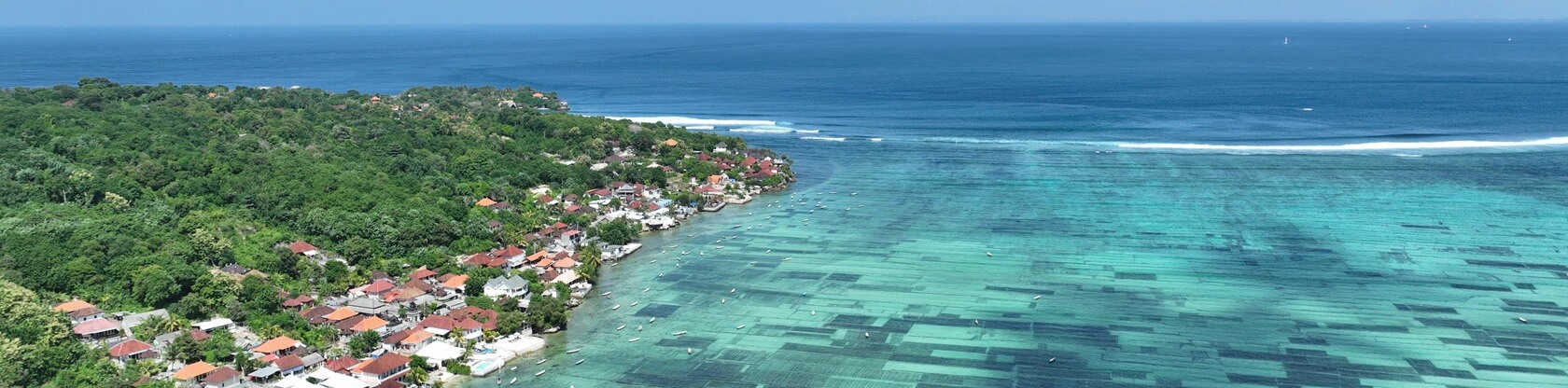
Unlike traditional agriculture, growing seaweed does not require huge plots of land. Ocean waters serve as a unique "farm", where seaweed seedlings are planted on the seabed or carefully attached to ropes or lines suspended on supports. This creates a fascinating underwater landscape, gently swaying to the rhythm of the current.
The seaweed harvest cycle is quite fast and, depending on the species, can take about a month and a half. Interestingly, the timing of harvesting is influenced by the lunar cycle. Farmers often harvest at the full moon and the new moon, when the seaweed is believed to reach its peak quality. The harvested crop is rinsed in fresh water, dried, packed into bags and sold to local entrepreneurs or sent for export.

Depositphotos
The island of Nusa Lembongan is the best place to see the farms in person. Here they are located along the coast and become especially noticeable at low tide, when the ocean retreats and opens entire "fields" of seaweed.
Walking through the shallows, you can watch farmers harvest by hand, tie new plants and dry the seaweed on the sand. This is not a tourist show, but part of the island’s everyday life. It is here that it is easiest to feel what real Bali looks like - without noisy resorts.

Depositphotos
The neighboring island of Nusa Ceningan is less known, but no less interesting. Here the farms look even more authentic, and there are noticeably fewer tourists. It is a good place for those who want to see the traditional way of life without extra fuss and take atmospheric photos.
Seaweed farms are an opportunity to see Bali from another side. There are no bright attractions or familiar tourist scenarios here, but there is a feeling of authenticity in island life.

Depositphotos
A visit to the farms is not an excursion in the usual sense, but rather an observation of island life. It is best to come at low tide, when you can go out into the shallows and walk among the lines where seaweed is grown. At this time the harvest is collected, brought to shore and laid out to dry. Sometimes you can talk to local residents and see the process from the inside. This experience is very different from the classic entertainment in Bali.
A visit to a seaweed farm on Nusa Lembongan is included in the program of some excursion tours from Bali.

Depositphotos
The best time to visit is the morning during low tide, when the farms are most open and access to them is easier. From the seasonal point of view, the most comfortable period is from May to September, when there is less rain and the sea is calmer. However, the farms work all year round, and even in the off-season they remain accessible for visits.

Depositphotos
It is convenient to go by speedboat from the resort area of Sanur on the south-eastern coast of Bali. The journey takes about 30-40 minutes, and trips operate daily. Upon arrival on the island, you can move around by scooter, on foot, or use a local transfer. Most farms are located not far from the coast, and the road to them takes no more than 15-20 minutes.

Depositphotos
Seaweed cultivation is considered one of the more sustainable types of aquaculture. Such farms help purify the water, absorb carbon dioxide and create a habitat for marine organisms. At the same time, the industry also faces challenges: tourism development, pollution and climate change can affect yields and the condition of ecosystems.

Depositphotos