What to see in South Sumatra: 12 main attractions of the region
By Anna Skumina
14.06.2026
South Sumatra - is one of the largest provinces of Indonesia, located in the south of the island of Sumatra. The region attracts travelers with its rich history, natural attractions, ancient monuments, and picturesque volcanic landscapes. This is where the famous Ampera Bridge, the Musi River, Lake Ranau, Mount Dempo volcano, and historical sites connected with the powerful Srivijaya state are located. If you are planning a trip around Sumatra, be sure to include these southern places in your route.

Depositphotos
Palembang - is one of the oldest cities in Indonesia. Many of the region's attractions that deserve attention are concentrated here.
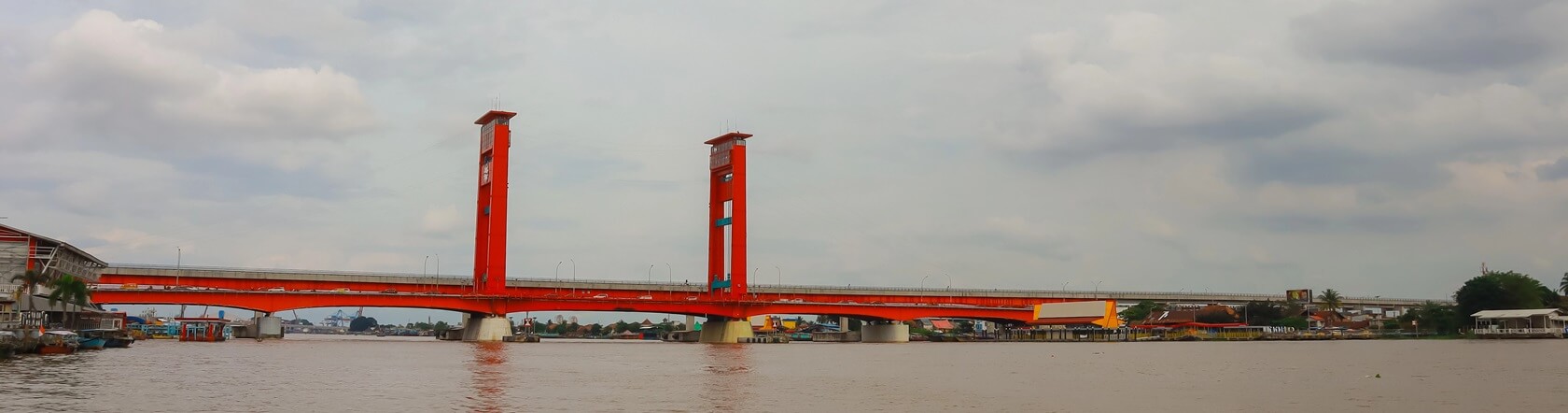
Ampera Bridge is the main symbol of Palembang and one of the most recognizable sights of Sumatra. The bridge crosses the Musi River and connects two parts of the city. Its construction was completed in 1965 during the time of President Sukarno. At first the bridge was called Bung Karno, but later it was renamed Ampera.
Ampera Bridge was designed so that its middle section could be raised, allowing ships to pass underneath it. Although the lifting mechanism no longer works, the bridge continues to serve as the main transport route connecting the two halves of the city. Its total length is 224 meters.
At night, Ampera Bridge comes alive thanks to colorful lights that illuminate the structure, creating a fascinating view against the background of the Musi River. It is a popular place, especially at sunset.

Depositphotos
The Musi River, vital for Palembang, - is one of the longest rivers in Sumatra, stretching for more than 750 kilometers. It plays a central role in the daily life of the city: along its banks there are floating markets, traditional stilt houses, and various historical sights. A river cruise on the Musi is a must for travelers, offering a unique perspective of Palembang's lively waterfront.
One of the main attractions of the Musi River - is Kemaro, a small island located about 6 kilometers downstream from Ampera Bridge. There is a Chinese temple on the island. It is also the site of the annual Cap Go Meh festival, which attracts many visitors. The island is wrapped in legends, and its nine-story pagoda is a prominent landmark with panoramic views of the river and the surroundings.

Depositphotos
The Monpera Monument, or Monument of the People's Struggle, - is an important historical landmark of Palembang that commemorates the struggle of the Indonesian people for independence and the sacrifices made during that struggle. Located near Ampera Bridge, this memorial stands as a tribute to the people who defended the city from colonial troops.
The design of the monument is unique: the 17-meter-high structure resembles a blooming flower. It also has 5 sides, each representing the residencies of South Sumatra. Inside the monument there is a small museum that displays artifacts and photographs telling the story of Palembang's role in the independence movement of Indonesia.
The Great Mosque of Palembang, also known as Masjid Agung Palembang, is an important religious and cultural landmark of South Sumatra. As one of the largest and oldest mosques in Indonesia, it reflects the rich culture and Islamic heritage of the region.
The mosque was originally built in 1738 by Sultan Mahmud Badaruddin, the ruler of the Palembang Sultanate. Over the centuries it underwent several reconstructions and expansions, turning into a grand structure.
Its architecture is a mix of different influences, including Chinese and Malay, which can be seen in its intricate patterns and decorative elements. Today the mosque remains an important religious and cultural center of South Sumatra.

Swarabakti, CC BY-SA 4.0, via Wikimedia Commons
Benteng Kuto Besak - is a historical 18th-century fort built by the Palembang Sultanate. It is located on the bank of the Musi River. The fort served as a royal palace and a stronghold for defense against colonial troops. Unlike many other forts in Indonesia, Benteng Kuto Besak is interesting because it was built by native people, not by European colonizers.
Today the fort is a symbol of Palembang's cultural heritage. Visitors can see the exterior of the fort, which is surrounded by high walls. The inner premises are currently closed to visitors, but the area around the fort is a popular place for walks.

Arisdp, CC BY-SA 3.0, via Wikimedia Commons
It is considered one of the most important archaeological sites in South Sumatra. Siguntang Hill (Bukit Siguntang) has enormous historical significance in Palembang. It is believed to be the burial place of revered ancient figures from the kingdom of Srivijaya, one of the most powerful maritime empires of Southeast Asia.
The hill is located about 4 kilometers from the center of Palembang and offers a panoramic view of the surroundings from a height of 30 meters. Fragments of ancient statues were found here and later placed in a museum.
Today the site has the status of an archaeological park, includes several ancient tombs, and attracts travelers interested in history and archaeology.
This historical site in Palembang includes 38 ancient burials and is dedicated to one of the city's most respected figures - Ki Gede Ing Suro - the predecessor of the kings of Palembang. He played an important role in the formation of the city's early government and Islamic teaching. His tomb, located in a peaceful place, is an object of religious tourism.
Al-Munawar village is one of the oldest Arab settlements in Palembang. It is located along the Musi River and is known for its well-preserved traditional houses. Some of them are more than a hundred years old.
Visitors can take a tour of the village to learn about its history, culture, and the daily life of its residents. Cultural events are also held in the village, allowing people to get acquainted with the community's way of life.

Depositphotos
Which natural sites are worth seeing in the region.
Punti Kayu - is a lush green corner located in Palembang. It offers a peaceful break from the city's bustle, which makes it a popular leisure place for families and nature lovers.
The park covers an area of more than 50 hectares and is home to a variety of flora and fauna, including towering pine trees, tropical plants, and various bird species. The well-kept paths of the park are perfect for slow walks, picnics, or simply relaxing in a calm setting. For those interested in wildlife, the park has a mini-zoo where visitors can observe animals and birds, including monkeys, deer, and peacocks.
The park offers a range of entertainment for visitors of all ages. There is a suspension bridge on the territory, as well as a small lake where you can ride boats. Horse riding is available, and playgrounds are equipped for children.
A majestic stratovolcano located in the Pagaralam area, about 6 hours from Palembang by car. This is one of the most remarkable natural attractions of South Sumatra. Rising 3,173 meters above sea level, it is a popular place for hiking and for nature lovers. The ascent to the summit of Gunung Dempo is a challenging but exciting activity. From here there are stunning views of lush tea plantations, dense forests, and the landscapes spread below.
For those who prefer a quieter holiday, the lower slopes of Gunung Dempo offer scenic walks through tea gardens, where you can get acquainted with the tea-making process and enjoy the cool mountain air.

Febi andika valendra, CC BY-SA 4.0, via Wikimedia Commons
Or Air Terjun Bidadari - is a hidden gem located in the lush forests of the Lahat Regency in South Sumatra. This charming waterfall, whose name means "Angel Waterfall," cascades down from a height of about 30 meters, creating a picturesque scene. The clear, cool water flows into a natural pool, which makes it a great place for swimming and relaxing.
Surrounded by dense tropical vegetation, Bidadari attracts nature lovers and adventure seekers. The hike to the waterfall is an adventure in itself, because you have to make your way through the forest and cross streams.
Lake Ranau is the second largest lake in Sumatra and one of the most beautiful natural attractions of the island. Located on the border between the provinces of South Sumatra and Lampung, Lake Ranau offers a peaceful escape surrounded by breathtaking scenery.
The lake appeared as a result of a volcanic eruption many centuries ago. Several rivers and streams feed it, and its waters are clean and reflect the surrounding mountains and lush green hills.
Boat trips, catamarans, banana rides, hikes in the surrounding hills, and other activities are available here. The lake is also known for its hot springs, which are believed to have healing properties.

Librarean, CC BY 4.0, via Wikimedia Commons