Money in Mauritius: currency, where to exchange it, and other details
By Viktoria Mudra
08.03.2026
When planning a trip to Mauritius, it is important to sort out financial questions in advance so that your holiday goes smoothly and without extra hassle. What currency is used on the island, whether dollars and euros are accepted, where it is better to exchange money, and whether it is possible to pay by bank card - all these details worry tourists no less than the weather or the choice of hotel. That is why we collected everything related to money in Mauritius in one article.

Depositphotos
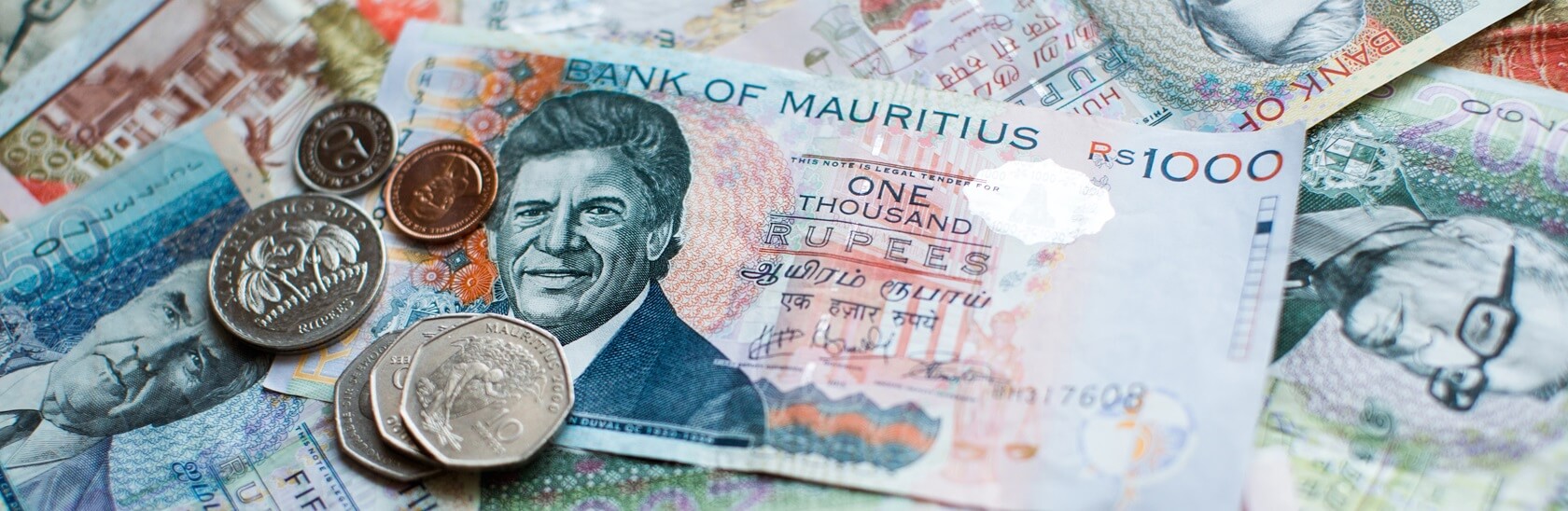
The official currency of the island is the Mauritian rupee. It was introduced in Mauritius in 1877, during British rule, replacing the pound sterling and the Indian rupee. Its international code is MUR, and on local price tags you will almost always see the symbol Rs. In Mauritius, bright and colorful modern polymer banknotes are used in denominations of 25, 50, 100, 200, 500, 1000, and 2000 rupees. But the first banknotes are still in circulation as well. On the front side of banknotes from 25 to 2000 rupees, there is a portrait, while on the reverse side of each banknote there is an emblem of one of the island’s districts. These include iconic landscapes such as Le Morne mountain and important historical figures. In addition, the Central Bank of Mauritius has issued Mauritian coins in 5, 10, and 20 rupees, as well as smaller coins in cents.
The current exchange rate is about 54 MUR for 1 euro, and 46 MUR for 1 dollar. Always check the current rate on specialized websites or directly on the spot. For a quick conversion, tourists often simply divide the amount in rupees by 50 to get an approximate value in euros or dollars.

Depositphotos
What currency should you bring with you, is it possible to withdraw money on the spot at a normal exchange rate, and how easy is it to pay by card on the island? These are all important points that directly affect your budget.
Do you need to exchange currency before the trip?
Do not try to find and buy Mauritian rupees in banks in your home country. First, it is almost impossible. Second, the rate will be extremely unfavorable. Just bring euros or dollars with you. Banknotes should not be damaged.

Depositphotos
A convenient start, but nothing more. Right after arrival, at Sir Seewoosagur Ramgoolam International Airport, you will see several 24-hour exchange offices. This is very convenient, and it makes sense to exchange a little money here for a taxi and small expenses. But remember that the rate at the airport is unfavorable, so exchange only a small starter amount here, for example, €100 or $100.
Tip: remember that exchanging Mauritian rupees back in your home country will be almost impossible. Try to spend them before departure on souvenirs at the airport.
Banks and official exchange offices are the best-value choice. You will always find the best rate in bank branches. The largest are Mauritius Commercial Bank (MCB), State Bank of Mauritius (SBM), Bank One, or licensed exchange offices such as Shibani Finance. They can be found in all major towns and tourist centers, such as Port Louis, Flic en Flac, and Curepipe.
Mandatory condition: for any currency exchange operation, you will need your passport.
Opening hours: banks are usually open from 9:00 to 15:00 from Monday to Friday. Some may work on Saturday morning, until 11:00. Exchange offices often have more flexible hours.
This option exists, but it should be avoided. The rate is almost always the least favorable, and the commission is high. Use it only in an emergency.
Exchange points at hotels may seem convenient, especially considering how common they are in tourist areas. But they rarely turn out to be a good solution. Rates are usually less favorable than withdrawing cash from an ATM or paying by card. In addition, the markup on the exchange rate is never shown clearly. This difference in rates can increase the cost of currency conversion.

Depositphotos
You can bring into and take out of Mauritius an unlimited amount of foreign currency. However, if you are carrying cash equivalent to $10,000 or more, it must be declared at customs. In some tourist places, foreign currency may be accepted for payment. But this is not worth doing. The rate will always be very unfavorable. Always pay in Mauritian rupees.

Depositphotos
The banking system on the island is very well developed. In most hotels, restaurants, large supermarkets such as Super U and Winners, and shops in tourist areas, international Visa and MasterCard cards are accepted. American Express and Diners Club are accepted less often, mainly in premium-class establishments.
Tip: before your trip, make sure to inform your bank that you are going to Mauritius. This can be done through the app or by phone. Otherwise, the security system may consider your very first transaction suspicious and block your card.
Cash withdrawal from ATMs
ATMs are easy to find all over the island, including outside the main tourist areas. But their number depends on the region. In rural areas or less populated places, ATMs may be less common.
To avoid losing 5-10% on every operation, you need to know a few details:
Tips: withdraw larger amounts, but less often, so there are fewer fixed fees. The best option is to get a special travel card before the trip, from Revolut, Wise, Fortuneo, or other neobanks, which offers reduced or free cash withdrawal abroad. It will pay off very quickly.

Depositphotos
International credit cards such as Visa and MasterCard are accepted in most hotels, restaurants, and shops in Mauritius. However, local markets, small shops, and some more remote places accept only cash payments. This also applies to street food stalls and small restaurants. Be careful with counterfeit banknotes.
Bargaining is part of the culture, but not everywhere. Feel free to bargain in markets when buying souvenirs, textiles, or handmade items. Prices for goods in stores and supermarkets are always fixed. Tips are welcome, but always check whether 15% VAT or a service charge has already been added to your bill.

Depositphotos