Car hire in Mauritius: prices, features and tips
By Viktoria Mudra
01.07.2026
Car hire in Mauritius is one of the most convenient ways to see the island beyond the resorts and popular beaches. If you plan to explore waterfalls, national parks and viewpoints on your own, renting a car in Mauritius will give you maximum freedom of movement. In this article, we will look at current car rental prices, the features of driving with left-hand traffic, and practical tips that will help you avoid common mistakes and make your trip comfortable and safe.

Depositphotos
What requirements, age limits and documents are needed for driving in Mauritius.
The minimum age for car hire in Mauritius is 20-21 years. However, for SUVs, convertibles and premium-class cars, the limit is often raised to 23-25 years. Drivers under 25 are often charged an additional "young driver" fee - usually from 10 to 20 euros per day. The insurance excess may be increased, and some car categories may be completely unavailable for rent.
As for driving experience, most agencies require that the driving licence was issued at least one year ago. Some companies, especially large international chains, set a minimum of two years.

Depositphotos
For tourist trips of up to four weeks, or one month, an international driving permit is not required in Mauritius. Your national licence is enough. If the licence is not in Latin script, an IDP will be required.
If you plan to stay on the island for more than a month, you need to arrange an international driving permit in advance, before departure. And if you plan to live in Mauritius for more than six months, you will have to exchange your licence for a local Mauritian one.

Depositphotos
At the rental desk, you will need to present four documents:
Please note: the credit card is the stumbling block for many travellers. The vast majority of rental companies - both major brands like Hertz, Avis and Europcar, and those listed on aggregators - require specifically a credit card, not a debit card. Some local agencies accept debit cards or cash, but they are in the minority. It is also worth noting that American Express cards are often not accepted in Mauritius. If you do not have a credit card, make sure to clarify this point with the specific rental company before booking.

Depositphotos
Prices depend on the category of car, the season, the rental duration and the chosen company.
Here are approximate daily rates in the low season:
For example: renting a compact Renault Kwid from the airport for one week in May will cost about 140 euros, around 20 euros per day, with unlimited mileage, basic CDW insurance, theft protection and third-party liability. In December, that is during the peak high season, the price for a car of the same class can rise by 30-70%.
Tip: if you are travelling with children, book child seats and boosters in advance, at the same time as the car. Their number is limited, especially in the high season. The cost is about 3 euros per day per seat. Some agencies provide them free of charge - check when booking. If you bring your own seat, make sure it is compatible with the car fittings.

Depositphotos
Mauritius has two clear peaks in tourist flow.
You need to book a car for these periods at the same time as you buy your plane tickets, otherwise you risk being left without a suitable vehicle. In the low season, May-June and September-November, the choice is wider and prices are the lowest.
Most agencies include in the price:
Fuel is always paid by the renter. As a rule, you receive the car with a full tank and must return it with a full tank.

Depositphotos
The deposit is blocked on your credit card when you collect the car and returned after it is handed back in good condition. The amounts vary significantly depending on the category of the car and the agency:
The rental price usually includes basic insurance that covers third-party liability and partial reimbursement of damage. However, it comes with an excess - this is the amount you pay from your own pocket in the event of an accident. The standard excess in Mauritius is from 500 to 750 euros per car.
You can buy the "full cover" option, CDW or zero excess. The cost is about 15-20 euros per day. For this small surcharge, you remove your financial responsibility in case of body damage, theft or collision. Considering that roads in Mauritius can bring surprises, especially in the first hours of left-hand driving, this may be a reasonable choice.
Even full cover usually does not apply to:
Read the list of exclusions carefully in the contract before you sign it.

Depositphotos
All major international chains are represented in Mauritius: Hertz, Avis, Sixt, Europcar. Their offices are usually located right at the airport and in major towns. The advantages are reliability, standardised service and predictable conditions. The disadvantage is that their prices are often higher than those of local companies.
There are also many small local agencies. Among them are those that offer a personal approach and convenient services, such as delivering the car anywhere on the island. However, there are also agencies that may impose hidden charges or try to deceive you when the car is returned.
The best way to find the best offer is to use specialised online aggregators.

Depositphotos
At the airport. Sir Seewoosagur Ramgoolam International Airport is located in the south-east of the island. This is an ideal starting point: representatives of rental companies wait right outside the arrivals area. You get the keys, sign the documents and immediately get behind the wheel.
Delivery to the hotel or villa. Many local agencies, and some international ones, offer delivery of the car directly to your place of stay anywhere on the island. This option is most often free. It is convenient if you want to rest after the flight, settle in, and start travelling the next day.
Split rental. Some travellers rent a car not for the whole stay, but only for the days when they plan active trips. The minimum rental period is usually 24 hours, although there are agencies that also offer half-day rentals.

Depositphotos
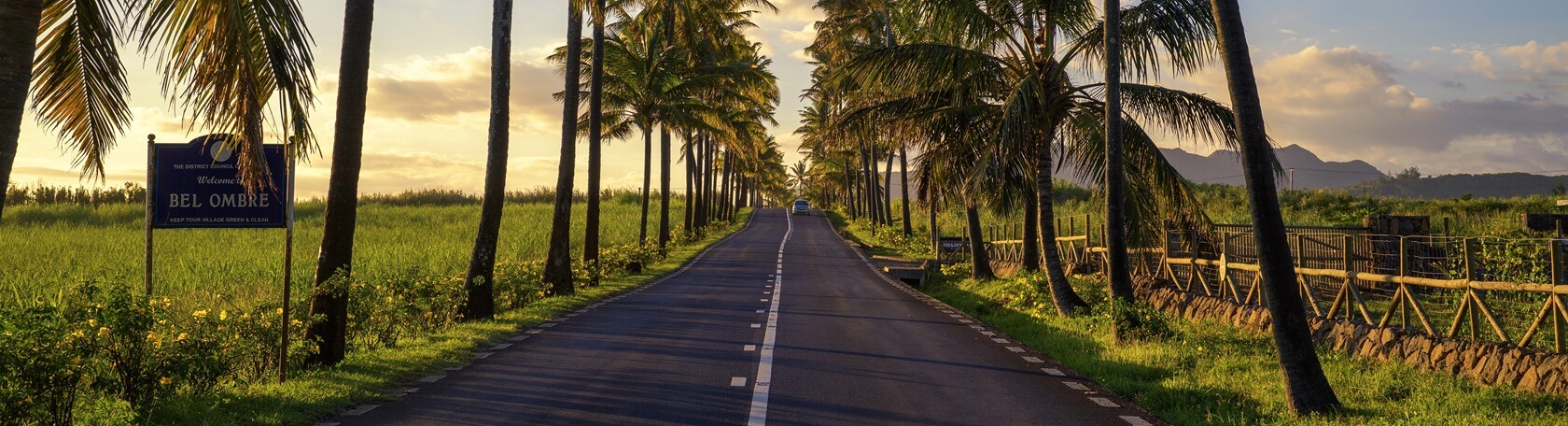
Motorways, M1 and M2. All roads in Mauritius are free, multi-lane and generally in good condition. The limit is up to 110 km/h, lighting is good and the road signs are clear. In recent years, roads on the island have been actively widened and modernised.
Main roads. Most roads in Mauritius are single-lane highways with a limit of 60-80 km/h. The surface is good, there is dividing road marking in most cases, but there are no pavements. This means that you will have to overtake pedestrians and cyclists. Mountain roads are a little narrower and require more careful driving.
Petrol prices in Mauritius are regulated by the state and are the same at all petrol stations on the island - 65-75 MUR, which is about 1.30-1.50 euros per litre. There is no self-service at petrol stations in Mauritius. The tank is filled by a station employee. Many stations close early, at 20:00-21:00, although some are open round the clock. Fill up closer to the evening so that you do not end up without fuel at night in rural areas, where the nearest station may be tens of kilometres away.
Almost everywhere on the island parking is free - near beaches, attractions, restaurants and shopping centres. The exception is the centres of large towns, such as Port Louis, Rose Hill, Curepipe and Quatre Bornes, where a paid parking ticket system applies. Tickets cost a few rupees per hour and are sold at nearby petrol stations or kiosks.
Buy a local tourist SIM card right at the airport. Google Maps and Waze work very well in Mauritius and are the most convenient and cheapest navigators. If for some reason you do not have mobile internet, download Google Maps offline maps in advance. Some rental companies offer a GPS navigator as an extra option, about 4 euros per day, others provide it free of charge. But a phone with a SIM card is easier and more reliable.

Depositphotos
Exceeding the speed limit by 15 km/h is punished by a fine from 2500 Mauritian rupees, about 50 euros. Drink driving is punished extremely severely: a fine from 20,000 to 50,000 rupees, imprisonment for up to five years and disqualification from driving.

Depositphotos